


Take a seat. Get comfortable. Now tell me, @HyperboreanHentaiEnjoyer69, how are you feeling today?

Politics is personal, which is to say, it is psychological, even biological. Our political worldview is influenced by trauma, hormones, and even our genes. I think National Socialism stemmed, in part, from the trauma of the trenches. I think hormones—like testosterone, cortisol, and estrogen—shape how people view gender roles. I think certain people are genetically predisposed to certain ideas. I think you could radically change the political landscape by putting trenbolone in the water supply. I think there’s a strong psychosexual dimension to the political.
That’s a long-winded way of saying that politics isn’t rational. It’s far more instinctual than we care to admit. Ideology is often shaped by deeply personal factors that seem totally unrelated to politics.
People who suffer from particular mental or emotional maladies are more likely to gravitate toward certain political ideas. In the case of schizophrenia, this connection is obvious. Due to their paranoia, schizophrenics are prone to conspiratorial thinking. But psychologists have also explored the more nuanced ways that psychology shapes politics.
Wilhelm Reich argued that sexual repression contributed to the rise of National Socialism. Theodor Adorno believed fascism stemmed from a family environment dominated by an authoritarian father figure. More recently, Jordan Moss and Peter J. O'Connor claimed that dark triad traits—psychopathy, narcissism, and Machiavellianism—“predict alt-right attitudes.” Aella, who manages to conduct research in between gangbangs, found a link between mental illness and political orientation.
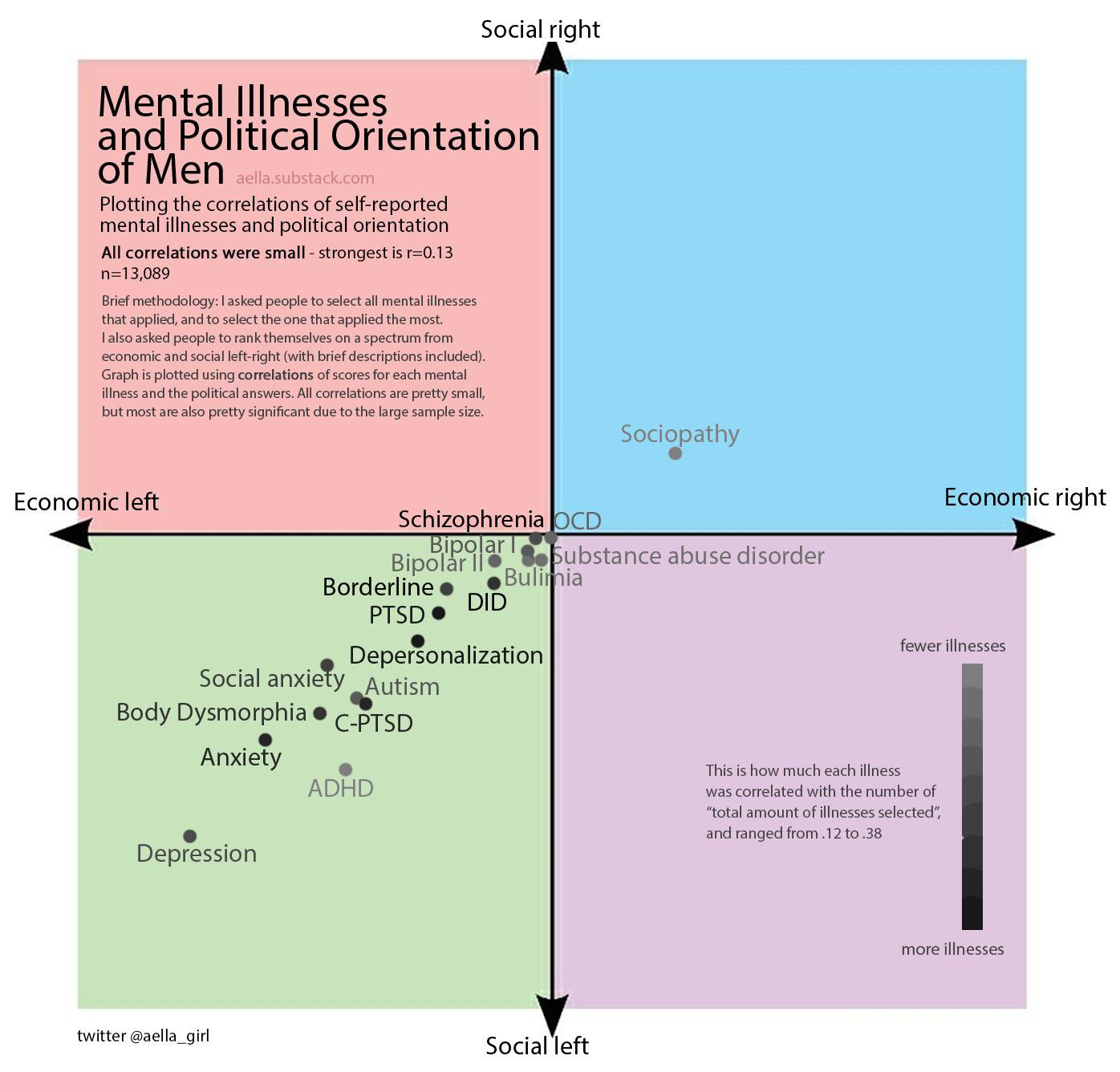
Psychological analysis of ideology is interesting, but often serves as a pretext for pathologising one’s political opponents. Too often, psychologists use their credentials to give political polemics a scientific veneer. Still, politics and psychology undeniably intersect, so I’ll indulge in a little armchair analysis myself.
In this essay, I want to psychoanalyse the online right—not to pathologise them (that’s been done to death)—but to highlight a real psychological affliction impacting many of its members: learned helplessness. This essay also serves as a blackpill detox protocol, offering practical steps to help readers break free from the doomer mentality.
What is Learned Helplessness?
Imagine holding a small mouse in your hand. You squeeze gently. It squirms and struggles violently. But after a few minutes, the struggle slows, then stops. It realises that the situation is helpless. Nothing it does matters.
Throughout our lives, we all experience moments like this. For some, they come early. As small children, they were left screaming in a locked room for hours. Eventually, they realised no one was coming. Like the mouse, they stopped struggling.
Fortunately, you probably weren’t neglected as a child. But you almost certainly have experienced helplessness—which is to say, a bad situation that was entirely beyond your control.
What happens to an organism when you put it in an inescapable situation? This question has been extensively studied by psychologists.
In 1967, Martin Seligman subjected dogs to inescapable electric shocks. The dogs initially squirmed and struggled, but eventually resigned themselves to their fate. Later, the dogs were placed in a new environment where they could escape the shocks by simply jumping over a low barrier. The inescapable situation was now escapable. And yet, most of the dogs made no attempt to escape. To quote Seligman:
They had concluded, or learned, that nothing they did mattered. So why try?
Seligman described this phenomenon as learned helplessness. Learned helplessness occurs when animals (or people) expect future events to be beyond their control based on their past experiences. This expectation erodes motivation and is almost identical to depression.
Depression & Learned Helplessness
What is depression? The answer depends on who you ask. In his 1917 paper, Mourning and Melancholia, Freud described depression as “a loss of interest in the outside world, the loss of the ability to love, the inhibition of any kind of performance and a reduction in the sense of self, expressed in self-recrimination and self-directed insults.”
Freud thought depression stemmed from unresolved childhood trauma (surprise, surprise!). As a small child, the depressed person was neglected by their mother, which filled them with rage. But because they couldn’t direct that rage at their beloved mother, they turned it inward instead. The depressive sees themselves as worthless and may even want to kill themselves, because depression is anger turned inward.
According to Freud, the only way to cure depression is to spend four years (and over $40,000) talking to Rachel Yentastein about your childhood. But eventually, you get tired of talking about castration anxiety, your unresolved anal fixations, and that one time your mum left you at Kmart. You turn to biomedicine.
The biomedical explanation of depression is a lot simpler. Depression is an imbalance of brain chemicals. This imbalance can be addressed through psychotropic intervention: Zoloft, Prozac, Lexapro, Paxil, Celexa, Effexor XR, ZogMAXX, etc. You don't need endless therapy sessions with a cigar-smoking nudnik. You need medication.
Freud insisted that depression began in the crib. Pharmacology insists that it’s hardwired into your brain. A third and more convincing explanation comes from Martin Seligman. Seligman noticed striking parallels between the symptoms of depression and learned helplessness. In fact, the two conditions appear almost identical.
After being subjected to inescapable shocks, the dogs in Seligman’s experiment ate less, drank less water, and consumed more alcohol when given the chance. They stopped caring for their puppies, lost their competitive drive, and didn’t defend themselves when attacked. They gave up easily on new tasks, wouldn’t explore new environments, and showed no interest in mating. They experienced insomnia, low energy, and psychomotor retardation.
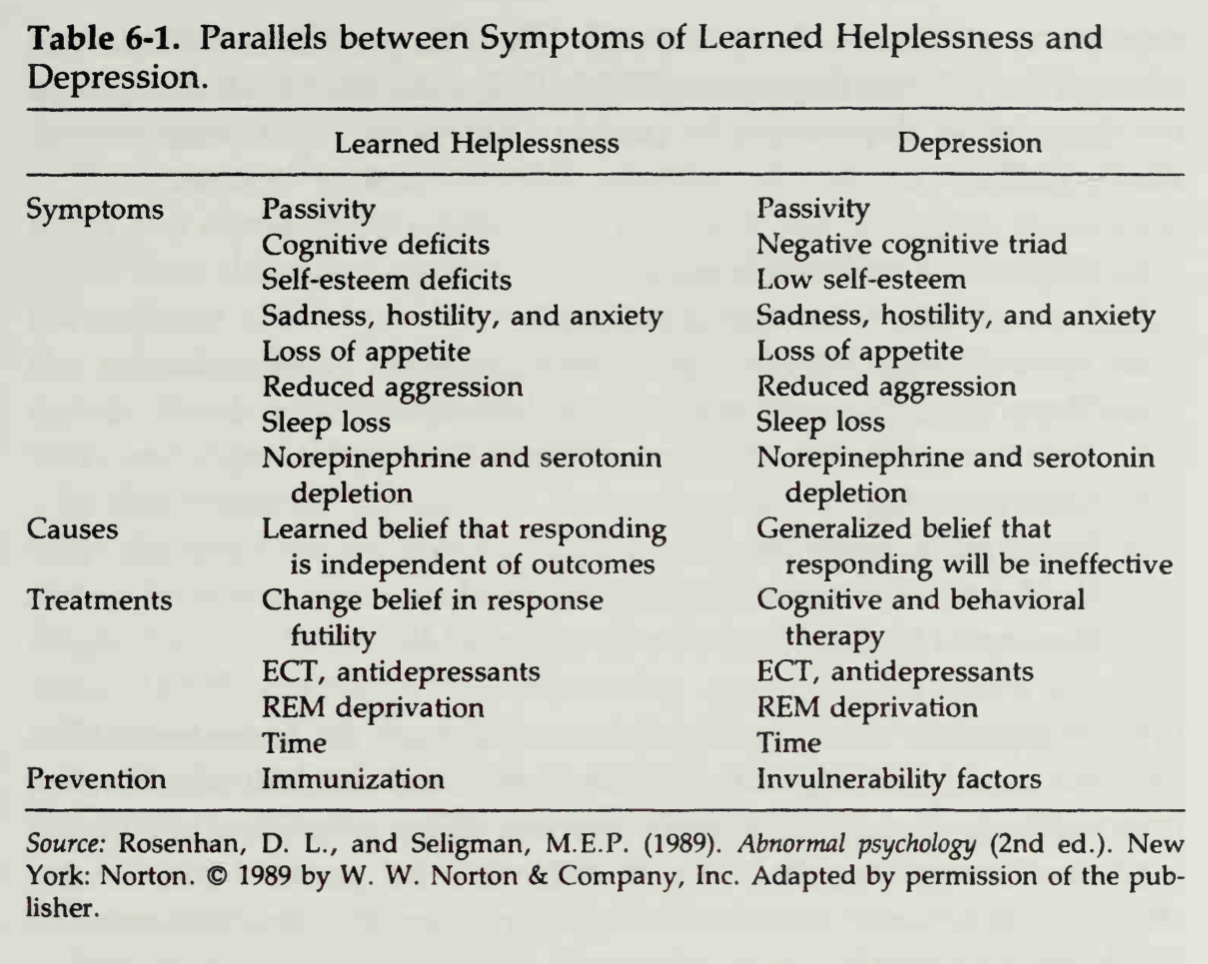
In short, they exhibited symptoms of depression. Seligman began to suspect that the proximal cause of depression was helplessness, rather than anger turned inward (Freud) or bad brain chemistry (biomedicine).
The link between depression and helplessness is clear. When something bad happens to you (i.e., you lose your job, GF, or hairline), you feel sad. Once you start to believe, with certainty, that there's nothing you can do to change the bad situation (i.e., you can’t afford a trip to Turkey), you become depressed. Like the dog in Seligman’s lab, you recognise the situation is helpless and stop thrashing about. Instead, you focus on conserving your energy. You become listless, lethargic and withdraw from life. I think depression is probably some kind of protective mechanism that helps you conserve energy in a helpless situation.
Seligman describes depression as “the common cold of mental illness” and estimates that about 25 percent of us experience it at any given moment. Usually, depression subsides after a few days or weeks. But in some instances, the symptoms persist for months, or even years. What explains this?
Seligman believes that prolonged depression can be attributed to a person’s explanatory style. To quote him:
The difference between people whose learned helplessness disappears swiftly and people who suffer their symptoms for two weeks or more is usually simple: Members of the latter group have a pessimistic explanatory style, and a pessimistic explanatory style changes learned helplessness from brief and local to long-lasting and general. Learned helplessness becomes full-blown depression when the person who fails is a pessimist. In optimists, a failure produces only brief demoralization.
In short, the difference between temporary demoralisation and full-blown depression comes down to one’s explanatory style.
Explanatory style is how you interpret negative events in your life. People with a pessimistic explanatory style see bad events as permanent and pervasive. For example, a bloatlord with a pessimistic explanatory style might think, “I'll never lose this weight” (a permanent explanation), and “because I’m fat, I’ll never be loved, never get a good job, and never be respected” (a pervasive explanation). The first belief convinces them that change is impossible, while the second extends one issue (obesity) across every aspect of life.
If this Rubenesque gentleman had an optimistic explanatory style instead, he would see his obesity as temporary (“I’ll lose this weight when I start dieting”) and specific (“This affects my health and appearance, but it doesn’t define my entire life”). In other words, he huffs on hopium rather than succumbing to learned helplessness.
Hopium leads to a greater sense of personal control, whereas pessimism convinces us that effort is futile.
Modernity and Learned Helplessness
According to a 2023 Gallup study, 29% of U.S. adults have been diagnosed with depression at some point in their lives. This number has increased by 10 percentage points since 2015.
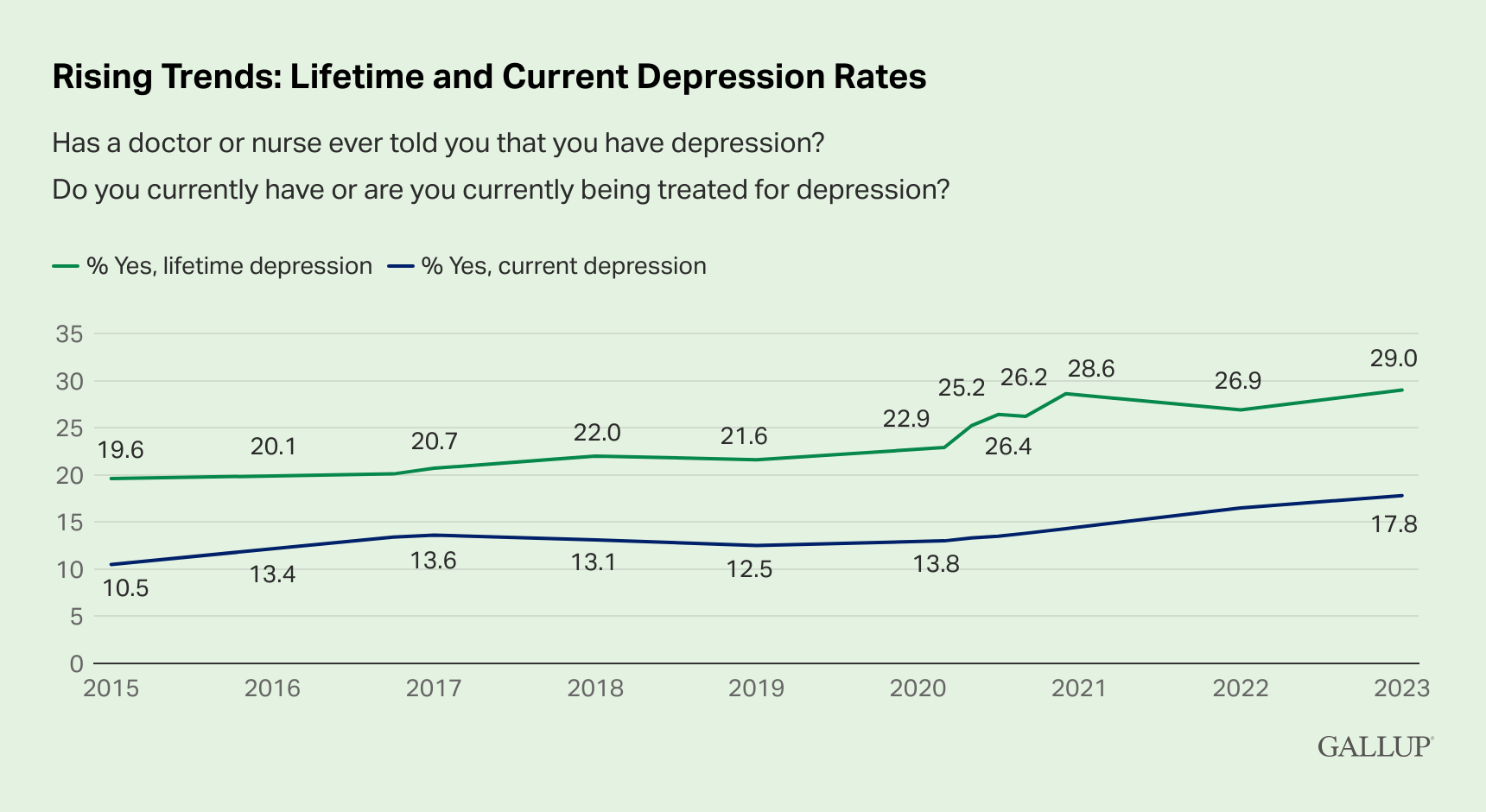
Some attribute the rise in depression to improved awareness and better diagnosis, while others blame secularism, social alienation, and the prevalence of digital technology. Both explanations are probably true, but there's a third that I want to consider.
The upsurge of depression could be interpreted as an epidemic of learned helplessness. An increasing number of people feel like nothing they do matters. As a consequence, they become depressed.
But this answer only raises another question: why do people feel like nothing they do matters? There are countless possible explanations, but at its core, I think modernity has eroded personal autonomy. This claim will strike some readers as absurd, since modernity claims to champion the cause of personal autonomy. But I think modernity erodes individual agency in ways that are often overlooked.
Agency means being in control of the core elements of your existence. The agentic frontiersman grew his own food, built his own shelter, and was his own lawman and judge. Today, most people are someone else’s employee, and lack the ability to pursue their needs autonomously. Instead, they rely on a vast network of bureaucrats, politicians, corporate executives and anonymous technicians to satisfy their most basic needs. This complex network is remarkably efficient, but it strips individuals of agency. To quote Uncle Ted:
Today people live more by virtue of what the system does for them or to them than by virtue of what they do for themselves. And what they do for themselves is done more and more along channels laid down by the system.
In short, modern man has change imposed upon him, whereas the 19th-century frontiersman created change himself.
COVID and Learned Helplessness
This loss of agency was made abundantly clear during the COVID-19 pandemic. At the time, I was living in Victoria, Australia, where the state government implemented the strictest lockdown in the Western world. The state effectively became an open-air prison, and citizens were treated like lab rats—or lab dogs, rather.
The Victorian government imposed a strict 8 p.m. curfew, used drones to monitor public spaces, banned playground usage and even arrested a pregnant woman for organising a protest on Facebook. The most mundane aspects of daily life—where you could go, who you could see, and even what exercise you were allowed to do—became subject to government oversight and control.
It was during this time that I learned just how susceptible people are to propaganda. I saw how easily they could be gaslit into reversing their beliefs. One week, COVID wasn’t a big deal; the next, it was the bubonic plague. Masks didn’t work, until they were mandatory. The vaccine would stop transmission, until it didn’t, then suddenly, “they never said that it would.”
I didn’t trust the vaccine. And no, I didn’t think that Bill Gates was trying to microchip me. I just no longer trusted The Science™. But it didn’t matter what I thought. The Victorian government made vaccination a condition of employment in pretty much every industry. I could vax maxx or become an unemployed chandala.
I depended on my job. I needed it to pay for groceries, rent, and everything else. Which is to say, I was a wagie, who couldn’t satisfy my basic needs autonomously. And so, after months of thrashing about, I ended up getting the vaxx. Like one of Seligman’s dogs, I lay down and passively accepted my fate.
The Blackpill
There is a collective amnesia surrounding COVID. People have chosen to forget it. And yet, our lives have been irreversibly changed by it. To my knowledge, no one has examined the subtle yet significant ways this event reshaped culture. Someone should write a book about the world before and after COVID. But perhaps it will take another decade before we can fully grasp the depth of these changes.
One of the most significant changes I’ve observed is the rise of hopelessness. During the pandemic, people had almost no control over their lives, and that sense of powerlessness didn’t end after the lockdowns. Many continue to feel at the mercy of forces beyond their control. This feeling is particularly pronounced among the online right, who even have a word for it: blackpilled.

The blackpill is learned helplessness. It’s the belief that a situation is so hopeless that it cannot be changed. A blackpilled person isn't just pessimistic—they’re resigned and withdrawn, because they believe that effort is futile. They believe that nothing they do matters. A blackpilled incel, for example, rejects the notion of self-improvement, because he believes that attractiveness is genetically determined at birth. His unattractiveness is, therefore, an immutable characteristic that cannot be changed.
This fatalism is pervasive, not only among incels but among the online right in general. This is an interesting development, considering that the right has traditionally emphasised agency, personal responsibility, and the power of individual action.
This shift in attitude is understandable, considering the challenges that young people face. The boomer bootstrap rhetoric is retarded. But I’m becoming equally frustrated with right-wing doomers. These people are starting to sound like kvetching leftists. Instead of capitalism or white supremacy, they complain about feminism, globohomo, the longhouse, etc. They gripe and whine about how hard their lives are. They reject the idea of agency, blaming shadowy elites (read: Jews) for all their problems.
It isn’t entirely surprising that the far right sound like leftists. As Robert Stark has pointed out, people on the edges of the left-right spectrum come from similar backgrounds. Both are overeducated and underemployed. Both are a product of downward mobility among the middle class. Both strived, and failed, to become part of the managerial class (academics, journalists, etc). Both are smart, but poor.
Politics is personal. It often stems from people’s petty resentments. The high-IQ, low-status individual typically gravitates towards leftism, because they resent capitalism. But intelligent, downwardly mobile white guys are increasingly drawn to the online right. They resent being gaslit about their privilege when their standard of living is deteriorating.
While understandable, this frustration often festers into a crab-bucket mentality. A large contingent of the online right take pleasure in dragging each other down. Anyone who tries to make money is a grifter. Anyone who tries to better themselves is a self-improoover. Anyone who starts a family is a contemptible wife guy. Nothing is possible or worth doing at all. Every conceivable course of action is gay and futile. The only solution is a final solution. Billions must die…

As A.M. Hickman notes, many people seem to get a kick from "imagining that nothing is possible.” Why is this?
I think this sort of cynicism is a coping mechanism that helps people repress the shame that naturally accompanies giving up. If everything is terrible, nothing is worth doing. Trying becomes pointless, even foolish. So you can resign from life with an air of superiority. Unlike the others, you get it. You’ve seen through the illusion. To quote Alex Kaschuta:
This revelation creates a special thrill: you've seen behind the curtain while others remain blind. Whatever the circumstances of your life, knowing the truth is a form of deliverance. Even if you think you're the only one, this hidden status is a flame that warms your wise soul. Others may have other forms of status, but their success is in the shadows because they are not lit up by the truth.
Unlike the normgroids, you’ve escaped the matrix. And yet, you haven’t really escaped anything. You’ve simply become aware that you’re trapped in a pod. People endlessly talk about how bad it is inside, but few actually want to break out. In fact, many appear to have developed a sort of Stockholm syndrome. They take masochistic pleasure in their own victimhood. Worse still, they need this victimhood to be endlessly affirmed by others. This, in essence, is what large sections of the online right have become: people endlessly affirming their own powerlessness.
The political and media landscape has changed beyond recognition over the past few years, yet many continue to believe the situation is helpless. Like the dogs in Seligman’s laboratory experiment, they fail to recognise that circumstances have changed. The stranglehold on speech has been broken post-COVID. The overton window has shifted. The media’s grip on the collective consciousness has been slipping. The long twentieth century is coming to an end. A new playing field is emerging. This calls for new tactics and strategies. Many will continue to heckle from the sidelines. Others will choose to step onto the field. As Alan Schmidt puts it:
They will work in education, whether in building parallel institutions or using their new-found freedom to push for radical change in our schools. They will work in family formation, creating covenant communities that are resistant to the homogenizing force of modernity. They will work in politics as the views once said over anonymous accounts and dark rooms become campaign slogans. They will create works of art in areas once totally controlled by their most ferocious enemies. There's practically nothing that's not available to those who want to make their ideals, once thought impossible, become reality.
Will you continue to heckle from the sidelines, anon, or are you going to step into the arena?
The White Pill
What will separate the chads from the chaff? There are countless things one could mention, but I think the fundamental difference is this: the men in the arena will overcome learned helplessness. They will reject the idea that action is futile. They will take the white pill.
Contrary to popular belief, the white pill is not naive optimism. In many ways, the white pilled individual is extremely cynical. So cynical, in fact, that they have become cynical about cynicism itself. They realise that blackpills aren't “hard to swallow truths”, as is so often claimed. They're sedatives that help numb the sting of personal failure. You see, it’s not my fault—it’s the Jews, women, the economy—anything and everything except me.
This stuff is Xanax for overeducated, underemployed men. And like Xanax, a massive black market has emerged to feed the demand. Many of your favorite political commentators are benzo dealers, distributing cope under the guise of brutal honesty. But perhaps the most brutal truth of all is that Western civilisation isn’t going to collapse. At least not anytime soon. And you’re going to spend your entire life anxiously anticipating a catastrophe that never happens.
Naturally, a doomer will respond by bringing up several unpleasant truths. What about demographic replacement, political disenfranchisement, or the erosion of the middle class?
The assumption behind these retorts is that the whitepilled individual simply doesn’t understand what’s going on—that their optimism stems from naivety. But as the meme below demonstrates, the whitepilled person isn’t ignorant of the blackpill. They have risen above it.
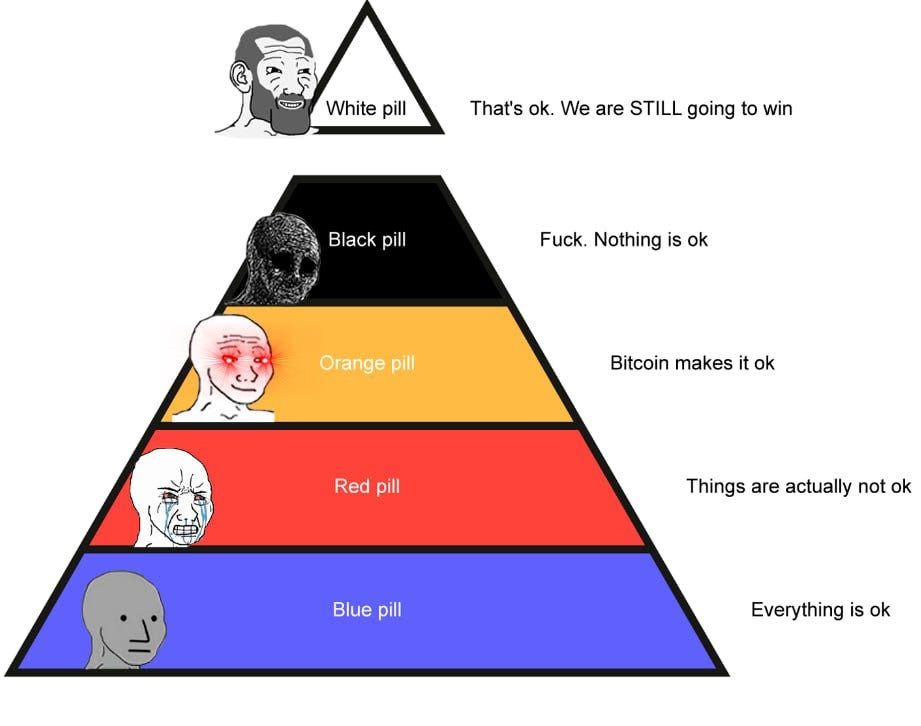
Unlike the doomer, they don’t have blackpills stuck in their digestive tract. They’ve actually managed to metabolise these harsh truths. They no longer ruminate on them, but focus instead of things they can control.
As has already been observed, modernity erodes individual agency in several significant ways. But some individuals manage to maintain a strong internal locus of control even in the most dire circumstances.
During the Vietnam War, James Stockdale spent eight years as a prisoner of war. Despite being mercilessly tortured by commies, he never lost his resolve. He was a follower of Epictetus, who taught him to focus on what he could control and accept what he couldn’t. This philosophy enabled him to endure unthinkable hardships in the Hanoi Hilton. He was tortured fifteen times, put in leg irons for two years, and put in solitary confinement for four years. And yet, he never lost faith that he would prevail. To quote him:
You must never confuse faith that you will prevail in the end—which you can never afford to lose—with the discipline to confront the most brutal facts of your current reality, whatever they might be.
You must confront harsh truths without succumbing to pessimism—because pessimism immobilises. According to Seligman, it promotes depression, inertia, and poor physical health. Optimism, by contrast, spurs action, shields against depression, and boosts immune function.
This isn’t about being a Pollyanna or sticking your head in the sand. It’s about putting yourself in the best psychological frame of mind to tackle the challenges that are coming. The rest of this essay will help you discover your own pessimistic tendencies, and introduce you to the techniques that help overcome them. A lot of you will dismiss these techniques as self-help Amerigoblin gobbledygook. But the Pentagon didn’t hand Seligman $31 million just for gigs. They recognised that his work could be used to train marines to avoid learned helplessness. If it works for them, it can work for you.
Blackpill Detoxification Protocol
A potential retort to everything I’ve said is that optimism, even if useful, is largely temperamental. Any attempt to cultivate it is, therefore, futile.
Optimism probably is partially heritable. No doubt, some people are naturally predisposed to a melancholic temperament. But I do believe that optimism can be cultivated. The doomer to bloomer meme is a perfect illustration of this fact. It suggests that even the most hardened pessimist can experience a radical shift in mindset.
A fitting analogy is bodybuilding: some people are high responders to resistance training, while others make slow progress. But almost everyone can build strength with consistent effort. Likewise, while some may have a genetic edge, anyone can develop a more optimistic outlook. Like heplessness, optimism can be learned. To quote Seligman:
A pessimistic attitude may seem so deeply rooted as to be permanent. I have found, however, that pessimism is escapable. Pessimists can in fact learn to be optimists, and not through mindless devices like whistling a happy tune or mouthing platitudes, but by learning a new set of cognitive skills. Far from being the creations of the popular media, these skills were discovered in the laboratories and clinics of leading psychologists and psychiatrists and then rigorously validated.
Like building muscle, optimism is developed through consistent exercise. Therapy is like having a personal trainer; helpful, but not necessary, because you can simply do the exercises yourself. In the section below, I outline how to do the exercises that are prescribed by cognitive behavioral therapists.
Exercise 1: Identify your Explanatory Style
Earlier in this essay, we spoke about explanatory style. A pessimistic explanatory style assumes bad things are both permanent and pervasive. If something is both permanent and pervasive, there’s no escape—so the logical response is to give up and conserve your energy.
Giving up makes sense when a situation is truly inescapable. But a pessimistic explanatory style can trigger the giving-up response inappropriately. Like the dog in Selgman’s lab, you can give up when escape is possible.
The first step in overcoming learned helplessness is simply identifying your explanatory style. You can do this by completing the test below. Simply circle the answers that apply most to you.